Listening without judgement is one of the best things you can do for someone with PTSD. Please keep HERE to go to original article in Good Housekeeping
BY MARISA COHEN
Good Housekeeping - Getty Images
Nearly one in 25 American adults has serious mental illness, which means odds are someone in your life is coping with anxiety, depression, OCD, bipolar disorder or another debilitating condition. Still, shame about mental illness — likely a holdover from when people wrongly believed such conditions were character flaws or a mother’s fault — can make it hard to seek help or even know what to say to those who struggle. To shine a light on the daily realities of mental illness, Good Housekeeping and the National Alliance on Mental Illness (NAMI) surveyed more than 4,000 people, and found that over a third had a close friend or relative with mental illness. In our special package on how to support loved ones with mental illness, women who live with these widely misunderstood psychological issues share what it feels like, and how you can make a difference.
Going through a frightening or heart-wrenching experience — losing a loved one, being injured or assaulted, witnessing an act of violence, even living through a pandemic — triggers a range of emotions, from sadness to anger to fear. For most people, the intensity of those feelings fades over time. But for the 6 to 7% of Americans who will suffer from post-traumatic stress disorder at some point in their life, the feelings can linger for months or years, and can even get worse over time.
“I would have reenactments of the sexual abuse I experienced,” says Rachel, 34, from Danville, PA. “I would have the same physical feelings and shortness of breath that I had when it was happening, and at times I would even disassociate. It was almost as if my vision was coming from above me and I was watching myself go through it. There was this intense feeling that I was living in one reality that was physical and another reality that was emotional, but no one could see the second reality except me.”
“I would have reenactments of the sexual abuse I experienced,” says Rachel, 34, from Danville, PA. “I would have the same physical feelings and shortness of breath that I had when it was happening, and at times I would even disassociate. It was almost as if my vision was coming from above me and I was watching myself go through it. There was this intense feeling that I was living in one reality that was physical and another reality that was emotional, but no one could see the second reality except me.”
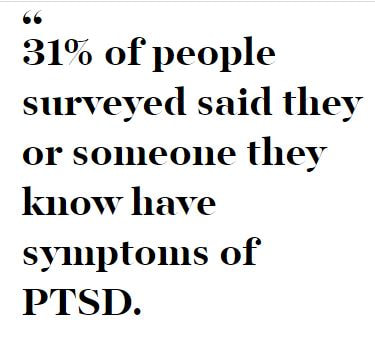 | Rachel's experience is typical of PTSD — a feeling of being in acute danger when in reality nothing threatening is taking place. “Trauma can impact the brain so that the system that regulates the flight-or-fight mechanisms that tell us when we’re in imminent danger don’t work as well as they did before,” says Ben Weinstein, M.D., chair of psychiatry at Houston Methodist Hospital. “Those systems become overactive, and people can have flashbacks, where they feel as if they're experiencing the trauma all over again.31% of people surveyed said they or someone they know have symptoms of PTSD. |
For some people, no matter how much they may want to leave the past in the past and move on with their lives, the flashbacks don't stop. “It plays in a constant loop in my head, like a movie. Even though I wish I wasn’t watching it, it pops on whenever it feels like it,” explains Melony, 38, from Baltimore. Simple, everyday interactions can trigger her PTSD, which stems from domestic abuse and assault. “Even a stranger getting too close to me makes me feel like I have to back away or run because they’re going to hurt me. It could be someone just looking at me — I get paranoid and feel like they’re trying to grab me.”
In addition to avoiding certain people and places, people with PTSD may feel like they’re constantly unsafe and on edge, which can affect their relationships. They may become detached emotionally as a protective mechanism, Dr. Weinstein says, adding that one of the most common symptoms is recurring nightmares and difficulty sleeping. It can sometimes be difficult for friends and family to understand why the person with PTSD continues to have trauma, even years after the event, which leads to further feelings of isolation. “Two people can experience the same events very differently, Dr. Weinstein says. “They can have a different interpretation and what happened may have a different impact on them.”
In addition to avoiding certain people and places, people with PTSD may feel like they’re constantly unsafe and on edge, which can affect their relationships. They may become detached emotionally as a protective mechanism, Dr. Weinstein says, adding that one of the most common symptoms is recurring nightmares and difficulty sleeping. It can sometimes be difficult for friends and family to understand why the person with PTSD continues to have trauma, even years after the event, which leads to further feelings of isolation. “Two people can experience the same events very differently, Dr. Weinstein says. “They can have a different interpretation and what happened may have a different impact on them.”
With proper treatment, many people suffering from PTSD can see their symptoms ease up or even disappear completely over time. Medications such as antidepressants and nightmare-reduction drugs can help, but psychotherapy is crucial. Some types of cognitive behavioral therapy designed to treat PTSD include prolonged exposure therapy, which uses imaging, writing and even visiting the place where the trauma happened to gradually expose the patient to their fears in a safe way, and cognitive processing therapy, which helps people make sense of their memories. Several studies have also shown the efficacy of Eye Movement Desensitization and Reprocessing therapy (EMDR), in which a therapist guides the patient in a series of eye movements, taps, or tones that can help decrease the emotional pain of traumatic memories. “Some people are afraid to seek therapy because they think it involves telling their story over and over again and re-experiencing it, but that’s not necessarily true,” Weinstein says. “Engaging with a therapist who specializes in trauma can be incredibly helpful and transformative.” Melony says that therapy saved her life. “I used to go one to three days a week for seven and a half years,” she says. “I started to feel more stable, because I finally got a diagnosis and was able to understand why my life was working the way it was."
When dealing with PTSD, support from loved ones is crucial. Here are ways you can be an ally to someone struggling:
- Don’t imply that there's a deadline for "getting over" it: Never say to a person with PTSD, But that happened so long ago, can’t you just move on? “This is not like breaking a bone, where it heals and you’re over it. The timeline is very variable,” says Dr. Weinstein. “For some people, it will naturally fade over time, but for other people it can continue to be very real and present in their daily life.”
- Listen without judgment: Instead of trying to explain away your friend’s fears or challenge their memory of the trauma, give them the freedom to be in charge their own narrative. “When you’re talking to someone who’s experienced emotional abuse, letting them be an expert on their life is so vital,” says Rachel, who explains that an abuser often convinces his victim that her feelings have no value and her words are unbelievable. Simply listening and asking "Can you tell me more about that?" is a powerful gift, she says.
- Ask about triggers and help make a plan: If your friend or family member knows that certain things can set off flashbacks or panic attacks (loud noises, news footage of war zones, or family gatherings, for example), ask in advance how you can help if they need it, and follow their lead.
- Don’t try to put a positive spin on the past: It can be really hard to hear about someone else’s trauma, so you may be tempted to say something like, “Well at least you weren’t permanently injured,” or “At least they finally arrested the guy.” Rachel says this happens quite often. “It makes me feel like I’m supposed to have thankfulness for what happened to me." Sitting with your friend while they talk about the most difficult parts of their story can help provide the sense of safety and trust they are trying to rebuild.
The COVID-19 crisis has made life more challenging for everyone — especially those who are struggling with a mental illness. Visit NAMI’s COVID-19 Resource and Information Guide for additional advice. For more info on PTSD, visit the PTSD Alliance.
Additional reporting by Lambeth Hochwald
MARISA COHEN Marisa Cohen is a Contributing Editor in the Hearst Health Newsroom, who has covered health, nutrition, parenting, and the arts for dozens of magazines and web sites over the past two decades.
 RSS Feed